Showing posts with label financial aid. Show all posts

Thursday, September 4, 2014

Colleges that meet 100% of a student's financial need

One of the biggest concerns students and their families have about college is affordability. Rising costs at the nation’s public and private schools keep qualified students from considering the best options.

Fortunately, many colleges are committed to remaining affordable to each admitted student regardless of their financial circumstances. A college or university that promises to make sure every penny of an accepted student’s demonstrated financial need is covered through grants, work-study, scholarships, and in some cases, federal student loans, is considered a 100% meet need school.

College Green light has compiled a list of the colleges around the country who identify themselves as 100% meet need, and have indicated the specifics of their programs below. Note that a major difference between meet need programs is whether or not the college includes federal student loans in a student’s financial aid report. The colleges that include student loans keep the amount a student is expected to borrow reasonably low. In these instances, check with the college’s office of financial aid for additional information.

If you are interested in learning more about any of these colleges or universities click on the link below to view their College Greenlight profile.

Note: 100% meet need schools pledge to meet a student’s full demonstrated need. Most students will still have an expected family contribution they are responsible for.

Link to schools and article: http://www.collegegreenlight.com/blog/colleges-that-meet-100-of-student-financial-need/

Meet Need Schools

Friday, June 6, 2014

RCAC's SUMMER 2014: DESTINATION COLLEGE

The Metropolitan Education Commission Regional College Access Center is very proud to announce the creation of the “SUMMER 2014: DESTINATION COLLEGE” presentation series. The RCAC College Interns Program will offer hour long presentations in subjects ranging from college admissions to scholarships and financial aid. The RCAC will also offer one on one college planning appointments for students participating in summer school and summer community programs. Contact DAVID J. RODRIGUEZ at djrrcac@gmail.com, or 520-670-0055 to schedule presentations and appointments. 

More info: http://www.metedu.org/rcac/Summer2014DestinationCollege.php

Metropolitan Education Commission - RCAC

Friday, May 9, 2014

I'm First Scholarship

This scholarship is for high school (or home-schooled) seniors who are attending school in the United States. To qualify, applicants must be first-generation college students, i.e., neither parent has earned a four-year college degree, and attend an I'm First partner college or university. Ideal candidates will display the following qualities: seeking financial aid and scholarship support for college, strong writing skills and unique perspective, strong capacity for reflection for blogging, experience with or commitment to community service, leadership experience, and commitment to helping expand educational opportunities for other first-generation students. Scholarship winners are not selected based on academic qualifications such as GPA, SAT/ACT scores, or intended majors. Undocumented students are eligible and strongly encouraged to apply.

Award: $1000

Deadline: May 23, 2014

More info: http://www.imfirst.org/scholarship/

Wednesday, January 22, 2014

How to Find Financial Aid if You Are Undocumented

How to Find Financial Aid if You Are Undocumented

By Raul Alvarez - College Greenlignt

If you are an undocumented student, there are still financial aid opportunities available to you. The key is figuring out exactly which opportunities are available to you based on where you live.

But before we dive into those opportunities, it’s important to recognize a few hard truths. If you do not have a social security number, you are not eligible for federal financial aid. That means you are not eligible for government loans, government grants, federal aid, and work-study programs that are financed by the government. This does not necessarily mean that you shouldn’t fill out the FAFSA, but you should check with your high school, after school, or college guidance counselor before you do.

There is still a huge push to change these policies so that amazing students like you can have access to these types of aid, but until those changes are made you’ll have to be especially diligent and creative.

Step one: start with your state

The first place to look for aid is your state. Several right-thinking states have enacted legislation that provides aid to undocumented students. The two major types of legislation these states have taken on are:

1. In State Tuition for Undocumented Students: this means that even if you are not a US citizen you can still be eligible to pay the same amount for a PUBLIC COLLEGE OR UNIVERSITY that any other in-state resident would receive.

2. State Financial Aid for Undocumented Students: this means that the state has financial aid that you can apply for to help you pay for college.

Here are a list of states with legislation that supports undocumented students:

California In State Tuition and State Financial Aid
Connecticut In-State Tuition
Illinois In State Tuition and State Financial Aid
Kansas In State Tuition
Maryland In State Tuition
Massachusetts In State Tuition
Nebraska In State Tuition
New Mexico In State Tution and State Financial Aid
New York In State Tuition and State Financial Aid
Oklahoma In State Tution
Oregon In State Tuition
Rhode Island In State Tuition
Texas In State Tution and State Financial Aid
Utah In State Tuition
Washington In State Tuition

If you live in any of these states, you can find out more information about their legislation at this link.

Step two: search for scholarships

There are hundreds and hundreds of scholarships that are available to undocumented students, as well as scholarships that do not require disclosure of citizenship. You should fill out a profile on College Greenlight in order to access our database of nearly every scholarship in the country. We make sure to list citizenship requirements with our scholarships.

We also have put together a list of scholarships that are specifically available to undocumented students that you can find here. 

And if you know of any scholarships for undocumented students, please let us know! We are always interested in adding these scholarships to our database, and in promoting them to our students. You can get started by sending an email to info@collegegreenlight.com.

Step three: speak with a teacher or counselor

If you do not already have a high school, after school, or college teacher or counselor helping you build your college plan, you should! Their job is to help you access education, regardless of citizenship. And while telling your story might be scary, you should know that their are so many people working in education that believe in you, us included! Another great place to find caring advocates is right here on College Greenlight. If you are currently not working with an after school program or other community organization that helps students get into college, let us know! Send an email with your name and the city you live in to ralvarez@collegegreenlight.com and I will try and help connect you with a great organization.

Step four: talk to your favorite college

If you have a college or university in mind that you’ve always wanted to go to, talk to them about your situation. If the college is any good, they’ll be happy to let you know of any opportunities they have for undocumented students.

Step five: don’t give up

We want to see the DREAM Act passed. We believe every student who wants to receive higher education and is serious about it deserves a chance. There are many great places you can get even more information if you are undocumented and are still wary of speaking with someone. One great place is at Educators for Fair Consideration, a not-for-profit website dedicated to helping undocumented students access to affordable higher education. We hope that someday, all students will have equal access to education. But the hard truth is that right now, they don’t. We hope this guide has been helpful, but if you have any suggestions on how to make it better, please let us know in the comments!

Link to article: http://www.collegegreenlight.com/blog/how-to-find-financial-aid-if-you-are-undocumented/

Monday, January 6, 2014

College Information Workshop - Mission Library - Jan. 11 and 18

College Information Workshop

Mission Library -  January 11 and 18, Mission Meeting Room, 11 am.-1 p.m. at Mission Library, 3770 South Mission Road, Tucson, AZ.

If you are college bound, learn about opportunities that are available to help you choose a college, get enrolled, and find financial aide sources. Learn about filling out the FAFSA form (Free Application for Federal Student Aid). Lap tops will be set up so you can access many of the resources while at the workshop and even start filling out applications. The workshop will be facilitated by Mission's Regional College Access Center Student Ambassador. Saturday, January 11, 2014 11:00am - 1:00pm: Mission Branch Library

Using the Metropolitan Education Commission website, you can explore resources available as you get ready to attend college. Get help navigating the many financial aid sources available and learn what information you need to fill out the FAFSA form. Saturday, January 18, 2014 11:00am - 1:00pm: Mission Branch Library. Using the Metropolitan Education Commission website, you can explore resources available as you get ready to attend college. Use library computers to fill out applications or the FAFSA form.

More info:  http://www.library.pima.gov/calendar/?ID=25690

Wednesday, May 29, 2013

University of Arizona Scholarships!

The University of Arizona scholarship website lets you view details about scholarships you are eligible for and choose to apply for them through the site. 

Answer questions that scholarship sponsors ask and match up to scholarships you are eligible.

The scholarship profile page allows you to edit your personal information and revisit previously answered questions.

Click here: https://scholarshipuniverse.arizona.edu/splash/splash.aspx

NAU scholarships and financial aid!

The Northern Arizona University financial website will help you find scholarship whether you are a incoming undergrad, grad student or a parent.

There's a net price calculator is designed to help you estimate your scholarship and financial aid options.  Please be sure to complete the entire process to ensure the best possible results.   

Click here: http://nau.edu/finaid/


NAU Athletics Logo

Thursday, April 4, 2013

I’m First Scholarship - $2000

Recognized by the National Scholarship Providers Association and Fastweb.com as 2012 Scholarship Provider of the Year, Center for Student Opportunity’sI’m First Scholarship is a $2,000, four-year renewable scholarship awarded to graduating high school seniors who will be first-generation college and are matriculating to a College Partner institution.
Scholarship winners have the unique privilege to serve as student bloggers on I’m First to share their college experiences and offer advice to aspiring first-generation college students on how to make it to and through college.
Minimum Eligibility Requirements:
  • Current high school (or home-schooled) seniors attending school in the United States.
  • First-generation college student (neither parent has earned a four-year college degree)
  • Must be attending an I’m First partner college or university. View College Partners.
Ideal candidates will display the following qualities:
  • Seeking financial aid and scholarship support for college
  • Strong writing skills and unique perspective
  • Strong capacity for reflection for blogging
  • Experience with or commitment to community service
  • Leadership experience
  • Commitment to helping expand educational opportunities for other first-generation students
Scholarship winners are not selected based on academic qualifications such as GPA, SAT/ACT scores, or intended majors.

Undocumented students are eligible to apply.

Click here: http://www.imfirst.org/scholarship/

Thursday, March 28, 2013

College Scholarships for TUSD Seniors - $500-$2000

Scholarships! College Scholarships for TUSD Seniors: The Educational Enrichment Foundation offers approximately 20 college scholarships to TUSD seniors who successfully complete all State and District graduation requirement. $500-$2000. Deadline: April 2, 2013.

Click here for more info: http://eeftucson.org/scholarships.html


Funk/Cordell Education Fund Scholarship

The Educational Enrichment Foundation’s Allocations Committee will award three (3) $2,000 one-year scholarships. Students will be notified no later than the first week of May. Scholarships may be used to attend an accredited public or private Arizona college or university. Payment will be made directly to the institution and may be applied to tuition, fees, and books.


Tucson Federal Credit Union/Pima Community College Foundation (PCCF) Moving Forward Scholarship

Pima Community College Foundation (PCCF) Moving Forward Scholarship is available to seniors who intend to graduate in May 2013 (or who graduated in December 2012 from any TUSD High School or Alternative Education program. The Educational Enrichment Foundation’s (EEF) Allocations Committee will award Ten $1,000 scholarships that can be used to attend Pima Community CollegeONLY. Students will be notified of the award the first week of May. The funds will be available prior to the start of school in the fall of 2013.


Kenneth Paulin Memorial Scholarship

The Educational Enrichment Foundation will award one $1,000 scholarship in memory of Kenneth H. Paulin, an innovative and much revered automotive technology teacher at Palo Verde and Sahuaro High Schools. Students will be notified no later than the second week of May. Scholarships may be used to attend an accredited public or private Arizona college, university, or trade school. Payment will be made directly to the institution and may be applied to tuition, fees, and books. The funds will be available prior to the start of school in the fall of 2013.



James C. Stewart Scholarship

The Educational Enrichment Foundation will award two $1,000 scholarships. Students will be notified no later than the second week of May. Scholarships may be used to attend an accredited public or private Arizona college, university, or trade school. Payment will be made directly to the institution and may be applied to tuition, fees, and books.


Lou Farber Memorial Scholarship

The Educational Enrichment Foundation will award one $1,000 scholarship. Students will be notified no later than the second week of May. Scholarships may be used to attend an accredited public or private college, university or trade school. Payment will be made directly to the institution and may be applied to tuition, fees, and books.


Jose Marquez, Vail Award

The Educational Enrichment Foundation will award one $1,000 scholarship. Students will be notified no later than the second week of May. Scholarships may be used to attend an accredited public or private Arizona college, university, or trade school. Payment will be made directly to the institution and may be applied to tuition, fees, and books. The funds will be available prior to the start of school in the fall of 2013.


Edie Wingate Memorial Scholarship

The Educational Enrichment Foundation will award one $500 scholarship. Students will be notified no later than the second week of May. Scholarships may be used to purchase text books and other related books at an accredited public or private college or university, Payment will be made directly to the institution and may be applied to tuition, fees, and books. The funds will be available prior to the start of school in the fall of 2013.


Marjorie Benson Memorial Scholarship

The Educational Enrichment Foundation will award one student a $4,000 ($1,000.00 per year for four years) scholarship. Students will be notified no later than the second week of May. Scholarships may be used to attend an accredited public or private Arizona college, university, or trade school. Payment will be made directly to the institution and may be applied to tuition, fees, and books. The funds will be available prior to the start of school in the fall of 2013.


Velma Castaneda-Titone Scholarship

The Educational Enrichment Foundation will award one student a $500 scholarship. Students will be notified no later than the second week of May. Scholarships may be used to attend an accredited public or private Arizona college, university, or trade school. Payment will be made directly to the institution and may be applied to tuition, fees, and books. The funds will be available prior to the start of school in the fall of 2013.


Tuesday, March 26, 2013

101 Ways to Pay for College

101 Ways to Pay For CollegeCollege students and parents are always looking for creative ways to finance their college education and reduce college expenses. It’s important to look at paying for college from every angle, from the school you choose to the way you finance your education. It’s also much easier to pay for college if your monthly expenses are well-managed, or you have a small income to tap into. Check out these 101 tips to pay for college!

COLLEGE PLANNING

  1. If you are a high school senior, apply to multiple schools so that you have several financial aid offers to compare.
  2. Take a look at colleges that are close to your home, or close to a relative you can stay with. If you can commute to school, you won’t have to pay for room and board.
  3. Carefully plan your school application and college testing expenses – they can add up!
  4. If able, take Advanced Placement tests while in high school to obtain college credit. Any credits you receive could enable you to graduate early, which would save you money in tuition!
  5. Your high school may have a program with a local community college that will allow you to take “dual credit” classes.
  6. See if your school has a tuition payment plan available.
  7. Consider attending a community college while you decide on your college major and save money to attend a 4-year school.
  8. If you are planning to attend a public school, consider attending one in the state you live in, to take advantage of lower tuition charges available to in-state students.
  9. Select your college dorm carefully. Some dorms may cost more because they are newer, or have additional facility/recreation fees attached.
  10. Select your campus meal plan carefully. If you use up your meal credits early, you will have to purchase additional credits. Most plans do not let you roll over unused credits to the next school year.
  11. Select your college major carefully. You’ll want to research future career options and salary expectations to make sure you will be able to afford to repay your student loan debt.
  12. If you are interested in joining the ROTC or the military, you may be able to have all or part of your college education paid for.

APPLY FOR FINANCIAL AID

  1. Fill out the FAFSA (Federal Application for Federal Student Aid) every year at http://www.fafsa.ed.gov/ to qualify for financial aid.
  2. Once you fill out the FAFSA, your school will send you an award letter with your financial aid package.
  3. If your family’s financial situation changes after you’ve already submitted your FAFSA information (i.e. job loss, medical emergency) work with your school’s financial aid office to see if you can obtain increased financial aid.

GET FREE COLLEGE GRANTS

  1. College grants are free – you don’t have to pay them back! Once you fill out the FAFSA, you are automatically in the running for federal and most state grants based on the financial information that you entered.
  2. If you are a graduate student, ask your financial aid office if there are non-need based grants available for your field of study (sometimes called fellowships).

APPLY FOR COLLEGE SCHOLARSHIPS

  1. If you are lucky, your school may award you with an athletic or academic scholarship. These types of scholarships often cover all 4 years!
  2. Ask your financial aid office if there are college scholarships available for your field of study, heritage, community, or hobbies.
  3. Ask your department (i.e. English, Science, Business) if there are scholarships available for your major. Your dean or professor may know about these scholarships, too.
  4. Look for college scholarships from your workplace, church, community, and organizations that you are involved with.
  5. Start a college scholarship search on the web with sites like Fastweb. Your personal profile that you set up will help you find scholarships that match your profile.

BORROW STUDENT LOANS

  1. The Federal Stafford Loan is a low-cost student loan, backed by the federal government. Your award letter will show how much you are eligible to borrow every year, or you can do additional research here.
  2. Graduate students can use the Federal Grad PLUS Loan , to supplement Stafford Loan funds.
  3. If you have maximized free money and federal loan options, consider using a private student loan to pay for college.

SAVE MONEY ON COLLEGE TEXTBOOKS

  1. Purchase used college textbooks at the college bookstore. Just make sure you get in line early – used textbooks get sold quickly.
  2. Look for new or used college textbooks online on sites like Ebay or Amazon. If you are able to find the majority of your textbooks with one vendor, you might qualify for free shipping or a volume discount.
  3. You can download certain popular textbooks for free from websites like Freeload Press.
  4. If you’re strapped for cash, ask your professor if you can use a previous edition of the textbook (older editions are usually less expensive).
  5. If you don’t need your textbooks once you’re done with them, sell them back to the bookstore or on sites like Amazon or Ebay.

MAKE EXTRA MONEY

  1. If you were awarded federal work-study on your award letter, you can earn extra money by working at your school or in your local community.
  2. If you were not awarded federal work-study money, ask your financial aid office if you can get on a waiting list in case there is an opening.
  3. Get a paid college internship. Many degree programs now require an internship to fulfill graduation requirements, but you’ll probably have to work harder to find one that pays.
  4. Ask your favorite professor if he/she needs an assistant.
  5. Look for part-time student jobs in your campus newspaper, on campus bulletin boards or in your college’s student activity office.
  6. Apply for part-time work at local businesses or restaurants.
  7. Ask friends and family if you can intern at their workplace.
  8. Start up a baby-sitting, pet-sitting or house-sitting business that you can run in your spare time.
  9. Find a summer job at a camp or local business .
  10. Sign up with your school or a local company to become a tutor. You may be able to make even more money by starting your own tutoring business.
  11. Creating websites is a lucrative part-time job for many students.
  12. Start your own business in your local community or online (just think Michael Dell).
  13. If you are majoring in photography, consider working as a wedding or portrait photographer in your free time. Your school may also hire student photographers to work at athletic games and school functions.
  14. Your school may hire students to work during athletic events.
  15. If you have school spirit, get hired by your school to give tours or allow a prospective high school student to live with you for the weekend.

REDUCE YOUR COLLEGE EXPENSES

  1. Work with a college advisor to make sure that you are taking the appropriate classes to fulfill your major and graduation requirements on time.
  2. Look for student travel deals on sites like StudentUniverse or STA Travel.
  3. Use student flight deals offered by airlines, like AirTran.
  4. If you will be flying extensively, sign up for a frequent flier program to earn free flights.
  5. Purchase your computer, software and accessories through a student discount program from Dell, Apple, HP or Microsoft.
  6. Use free campus transportation whenever possible.
  7. Split your campus parking pass with a friend, and share the cost. If you don’t want to buy a parking pass, consider parking off-campus.
  8. Walk, bike or skate to school.
  9. Carpool to school or work with a friend or roommate.

MANAGE YOUR LIVING EXPENSES

  1. Rent or dorm fees are generally the second highest education expense, after tuition. Shop around to findcollege apartment move-in specials for college students.
  2. Find roommates to split your living expenses.
  3. Consider doing without, or reducing, monthly expenses like cable, telephone and entertainment expenses.
  4. Buy used furniture on Craigslist or through campus newspaper ads.
  5. Purchase student discount cards, or look for student discounts at local restaurants and businesses.
  6. Reduce food expenses by cooking more at home, instead of eating out.
  7. You may be able to get free room and board by signing up to be a dorm monitor or resident assistant.
  8. Some college apartment complexes provide free or discounted rent for students who refer other tenants to the building.
  9. Join your family’s cell phone plan (it’s usually cheaper than getting your own). Check your account frequently online or on your phone to make sure you don’t go over your allotted minutes or text messages.
  10. Use free websites like Facebook or Flickr to communicate with friends and family, and share pictures for free.
  11. Communicate using inexpensive or free internet calling services, like Skype. You can also talk for free on some instant messengers, like MSN, if both parties use headsets or microphones.
  12. Start using coupons at the grocery store, local restaurants or department stores.
  13. Bring your own snacks to class, so you won’t be tempted to buy anything from the vending machine or cafeteria.
  14. Some campuses have free Wi-Fi. Check to see if it’s in a convenient location to avoid paying for internet.
  15. Look for free events happening on campus, like movie screenings, rather than going to the movie theater.
  16. Never turn down free food around campus (club meetings, events, etc).
  17. Ask about free student checking and savings account at local banks.

DEBT MANAGEMENT

  1. Use cash or student loans to purchase textbooks, food and other college expenses instead of a credit card.
  2. If you need a credit card, make sure you get one with no annual fee and a low interest rate.
  3. Save money in interest by paying more than the minimum on your credit card.
  4. Save big money by paying the interest on your unsubsidized student loans every month while you are in school, if you are able.

GIFT IDEAS

  1. Send your family and friends your high school graduation invitations, along with a letter explaining your college intentions. They may just send you contributions to your college fund.
  2. Ask family and friends to contribute to your 529 College Savings Plan or another type of college saving account in lieu of birthday or holiday gifts.
  3. Ask family and friends to donate furniture for your apartment or dorm room.
  4. Ask a relative to give you a loan, that you will pay back with interest. Make sure you draw up the appropriate paperwork to protect both parties.
  5. If your relatives are about to get a new computer, ask if they will give you their old one!

PARENTS

  1. Pay for all or part of college expenses with your personal cash or savings.
  2. Create a 529 College Savings Plan for your child’s education.
  3. Some states will allow you to lock in today’s tuition prices through a 529 Pre-paid Tuition Plan.
  4. Help your student find and apply for college scholarships.
  5. Ask your employer if they offer scholarships for employees’ children.
  6. Take out a Federal PLUS Loan in your name to help pay for your child’s education.
  7. Help your child obtain a private student loan by co-signing.
  8. If you have a lot of unnecessary items around the house, consider holding a garage sale or selling items onEbay and using the funds for your child’s education fund. Also, many household items can be donated to charity, which would save you money on taxes that you can then use to help pay for your child’s education.
  9. Help your student create a budget and stick to it.
  10. Many parents have to reduce their monthly expenses while their child is in college, in order to have enough left over to pay their child’s food and living expenses while he/she is in college.
  11. Purchase airfare for your child to come home well in advance to save money in travel costs.
  12. Mail your student care packages with food and study supplies to help reduce spending needs. Weigh the cost of mailing a grocery gift card rather than mailing food items; it’s probably much cheaper to send a gift card than a heavy package.
  13. If your student needs a credit card, consider adding him/her to one of your accounts. Chances are your card’s interest rates are better than what he/she could qualify for, and you can keep an eye on college spending.
  14. If you are paying for college expenses, make sure you look into all of the tax deductions available to you.

AFTER COLLEGE

  1. Sign up for the Peace Corps, Americorps, or similar volunteer organization after college. In exchange for your service, you may receive money towards your student loan debt.
  2. If you work in a public service job for 10 years while making payments on your student loans, the government will forgive the rest of your student loan debt. To receive this benefit, your loans must be consolidated into a Direct Loan held by the Department of Education while you make payments, so consider consolidating as soon as you leave school and your grace period expires.
  3. Consider working for an employer in the private field that offers student loan payoff as an employee benefit.
  4. See if your occupation has jobs that qualify you for loan forgiveness in exchange for a certain number of years in public service (Ex. teacher, physician, nurse, lawyer).
  5. Live at home after college. You can use the money you save in rent and expenses can help pay off your student loans.
  6. Paying more than the minimum on your student loans will reduce the amount you will pay in interest, and pay the loans off faster.
  7. Use your student loan interest as a tax deduction every year, if you qualify.

Monday, March 25, 2013

How to Pay for College


The rising costs of higher education are showing no signs of letting up. In order to make it through, you must have a plan.

For students attending a public college or university in the state in which they live, tuition averages $7,000 per year. Private colleges run around $37,000 per year, with the highest-price private schools costing more than $50,000 a year. Paying those hefty bills requires a plan that includes an examination of how much you want to pay now versus how much you are willing to finance with loans. Here are a few things to keep in mind as you set out to pay for college:

Cash is king. How much can you really afford to spend over two to four years? Also consider how that cost might affect you or your children over that time.                                                                                      
  • Set up a payment plan. Many schools let you set up a monthly payment plan, which spreads the payments over several months rather than just one payment per term.
  • Keep saving. Even when you or your children are in school, every dollar you pay up front saves nearly $2 in interest if were to borrow that dollar.
  • Stick to a budget: A number of college budgeting tools are available atBankrate, The Federal Direct Loan program web site and FinAid.
Get a scholarship. Scholarships are not just for good students or low income families. There are scholarships for everything from vegans to students with the last name Zolp. It takes time and effort to find them and apply.

  • Cast a wide net. Consider scholarships from you hometown, college or workplace. And don't quit trying. Some scholarships are only available to students who are already juniors or seniors in college. Others are available to older students, and some states offer grants for laid-off workers returning to school to retrain.
  • Check in. Become best friends with your school's financial aid office. They'll know what's available on campus as well as some less well-know sources.
Borrow only as needed. Students who graduated with Bachelor's degrees in 2010 left school with more than $25,000 in student-loan debt, according to Finaid.org.
  • Complete the FAFSA. The first step is to complete the Free Application for Federal Student Aid (FAFSA) available online at http://www.fafsa.ed.gov/. It determines your eligibility for Federal Student Aid programs such as Pell Grants, Stafford Loans and PLUS Loans.
  • Start with the feds. Always start with federal loans, which are available to both parents and students, before opting for private loans from banks and other lenders. The federal programs offer some of the best interest and repayment terms including opportunities to have the loans forgiven for public service work and payment deferred if there's job loss.
  • Then go to the states. Many states also have state lending authorities, which provide loans to students from that state or who attend school in that state. These typically require a co-signer and good credit score.
What not to do when trying to pay for college.

  • Don't get in over your head. Figure out ahead of time about how much you'll owe after four years, and don't use credit cards to pay for tuition, books, and other necessary expenses.
  • Don't drain retirement savings. It's tempting to raid retirement accounts, but advisers warn against it because you can finance college but no one is willing to lend you money for retirement.
  • Don't suppress financial hardship. If something changes at home a job loss, medical event, or another sibling at school contact your financial aid office. You may be eligible for more aid or work study.


Thursday, February 28, 2013

Borrow Smart!

Borrow smart. If you or your family must borrow to pay the bills, stick with government-sponsored Stafford loans for students and PLUS loans for parents (or a home-equity line of credit, if you qualify). Current interest rates on government loans are 6.8% for students (lower if you’re eligible for financial subsidies) and 7.9% for new PLUS loans (for more information on student loans, go to StudentLoans.gov). With that combination, you shouldn’t have to resort to more-expensive private loans. Remember, though, that a subsidized student loan can be a two-edged sword, encouraging kids to borrow more than they should.
Read more at http://www.kiplinger.com/article/college/T042-C002-S001-7-strategies-to-avoid-the-student-debt-trap.html#ut5FL0M11oqaOCx3.99 


StudentLoans.gov. This site is your source for information from the U.S. Department of Education about how to manage your student loans.

Monday, February 25, 2013

Federal Pell Grants - Up to $5550 a year!

Federal Pell Grant, unlike a loan, does not have to be repaid. Federal Pell Grants usually are awarded only to undergraduate students who have not earned a bachelor's or a professional degree. (In some cases, however, a student enrolled in a postbaccalaureate teacher certification program might receive a Federal Pell Grant.) You are not eligible to receive a Federal Pell Grant if you are incarcerated in a federal or state penal institution or are subject to an involuntary civil commitment upon completion of a period of incarceration for a forcible or nonforcible sexual offense. 

Click here: http://studentaid.ed.gov/types/grants-scholarships/pell

How much money can I get?

Amounts can change yearly. The maximum Federal Pell Grant award is $5,550 for the 2012–13 award year (July 1, 2012 to June 30, 2013). The amount you get, though, will depend on

  • your financial need,
  • your cost of attendance,
  • your status as a full-time or part-time student, and
  • your plans to attend school for a full academic year or less. 
You may not receive Federal Pell Grant funds from more than one school at a time.
If you’re eligible for a Federal Pell Grant, you’ll receive the full amount you qualify for—each school participating in the program receives enough funds each year from the U.S. Department of Education to pay the Federal Pell Grant amounts for all its eligible students. The amount of any other student aid for which you might qualify does not affect the amount of your Federal Pell Grant. 
Federal Student Aid, an office of the U.S. Department of Education: Proud sponsor of the American mind.


Odenza Marketing Group Scholarship - $500

To apply for this scholarship, applicants must submit two small essays, one related to travel, and the other on why they deserve a scholarship.

Eligibility: Odenza Marketing Group Scholarship

Odenza Marketing Group Spring Scholarship
Deadline: March 30th, 2013
Award Value: $500

To be considered eligible for the Odenza Marketing Scholarship you must:

A) Be between the ages of 16 and 25 on March 30th, 2013

B) Submit answers to the essay questions, which can be found on the application page, prior to the March 30th, 2013 deadline.

C) Have at least one full year of post secondary studies remaining at the time of the award

D) Have a GPA of 2.5 or greater.

E) Be a citizen of the United States or Canada

The scholarship winner will be announced on or around April 30th, 2013 and will be posted on this website immediately after. All applications must be received by 11:59pm ET on March 30th, 2013. No late applications will be reviewed.

GO TO APPLICATION

Free Money for College-Paying for School with Grants

Grants are a wonderful way to finance your college education, because unlike loans they do not have to be paid back. Students can receive grants from a variety of sources, including private organizations, educational institutions, professional associations, and federal and state governments. 

Grants may be awarded based on a student’s financial need, ethnicity, religious affiliation, record of achievement, association, or special interests. 

Click here:  http://businessmajors.about.com/od/payingforschool/a/GrantsOverview.htm

About.com

Click on the links below to learn more about the different types of grants that are available

  • Federal Pell Grant - The Federal Pell Grant Program provides grants to undergraduate and postbaccalaureate students. Grants are need-based and are designed to help low-income students pay for schooling. Grant amounts are dependent on the cost of education and the student's expected family contribution (EFC).
  • Federal Supplemental Education Opportunity Grant - The FSEOG Program supports post-secondary education by providing need-based grants to low-income undergraduate students. Grant amounts vary. Students who get this grant typically have a very low EFC and are usually Federal Pell Grant recipients.
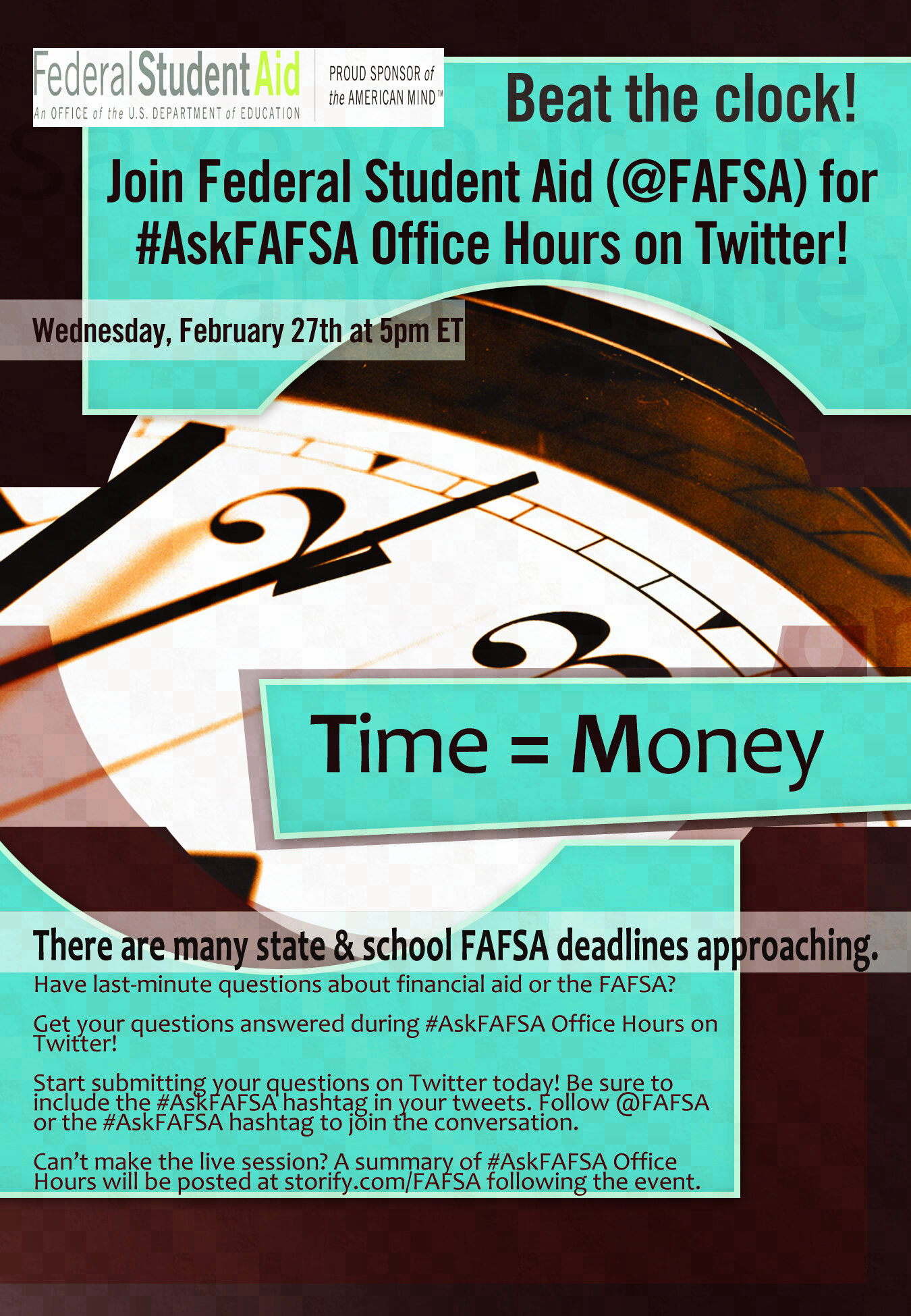
  • Ask FAFSA Q & A Wednesday, 2/27 at 5pm ET!

    Ask FAFSA! Office Hours are back, this Wednesday, 2/27 at 5pm ET! Start tweeting your questions today! More info: 
    https://twitter.com/FAFSA/status/306102285740691457/photo/1

    https://twitter.com/FAFSA


    Thursday, February 14, 2013

    Religious Liberty Essay Scholarship Contest

    This scholarship is for high school juniors and seniors. To apply for this scholarship, applicants must write an essay on a given topic about religion. The grand prize for this contest includes a trip for two to Washington, D.C.

    Click here: 
    http://www.cappex.com/page/scholarships/details.jsp?scholarshipID=1202

    Deadline: March 1

    Award Range: $250-$2,0000

    Awards Granted: 3

    2013 Essay Contest

    Bluewolf Technology Scholarship

    This scholarship is for US high school seniors who showcase an outstanding aptitude and passion for technology. To qualify for this scholarship, applicants must to plan to attend an institution of higher learning.

    Click here:
    http://www.cappex.com/page/scholarships/details.jsp?scholarshipID=37787

    Deadline: Mar 1


    Class Year:
    • High school senior
    Area Of Study:
    • Communications Technologies/Technicians and Support Services
    • Computer and Information Sciences and Support Services
    • Engineering
    • Engineering Technologies/Technicians
    • Mechanic and Repair Technologies/Technicians
    • Military Technologies
    • Science Technologies/Technicians


    Anne Frank Outstanding Scholarship Award

    This scholarship is for graduating high school seniors who are community leaders. The scholarship award recognizes students who exemplify the commitment, ideals, and courage that Anne Frank represents today. Examples of such activities include acting as spokespersons for tolerance; on a daily basis, having the courage to be bridge builders and peacemakers; creating/participating in programs that address intolerance, violence prevention, and conflict resolution; and standing up against intolerance by leading or participating in community-based organizations. To qualify for this scholarship, applicants must have been accepted into a four-year college.

    Click here: 
    http://www.cappex.com/page/scholarships/details.jsp?scholarshipID=3534

    Deadline:Mar 1
    Average Award   $10,000

    Class Year:
    • High school senior
    More Requirements:
      Must be a community leader


    Visine Students with Vision Scholarship

    This scholarship is for high school seniors and college freshmen, sophomores, or juniors who have a clear vision or goal and are able to communicate their vision through a well-written essay or video presentation. To qualify for this scholarship, applicants must demonstrate financial need, have a minimum 2.8 GPA, and be able to demonstrate involvement in school activities and/or community service. To apply for this scholarship, applicants must submit an essay or video that explains their clear vision or goal. In addition to the essay or video, academics, leadership in community service, and involvement in extracurricular activities will be considered. Employees of Johnson & Johnson Healthcare Products Division of McNEIL-PPC, Inc., ISTS, Inc., their affiliates, subsidiaries, advertising and promotion agencies, and the families of each are not eligible for this scholarship. 

    Click here:
    http://www.cappex.com/page/scholarships/details.jsp?scholarshipID=38033

    Deadline: Mar 1

    Average Award: $5,000Awards

    Granted:10


    GPA:
    • 2.8
    Financial Need:
      Financial need will be considered.
    Class Year:
    • High school senior
    • College freshman
    • College sophomore
    • College junior